Artificial Intelligence
Exxact Valence with GB300 vs. 4x RTX PRO 6000 for Agentic AI: One Big Model or Many at Once
September 14, 2026
10 min read

Agentic AI workloads rarely fail because a team picked the wrong GPU. They fail because a team picked the wrong shape of hardware for the workload. A single agent orchestrating a 200 billion-parameter model with long context needs a very different memory layout than a team running a dozen smaller agents in parallel, and the two most common local-AI answers today, the Exxact Valence with GB300 and a tower carrying four NVIDIA RTX PRO 6000 Blackwell GPUs, are optimized for exactly those two different shapes. Neither wins outright. The right pick depends on whether the workload goal is one large model or several independent ones running at the same time.
The Exxact Valence with GB300 is built on NVIDIA's DGX™ Station architecture, centered on the GB300 Grace Blackwell Ultra Superchip: a 72-core Grace CPU and a Blackwell Ultra GPU joined by a 900GB/s NVLink-C2C interconnect. The CPU and GPU share a single coherent memory pool of up to 748GB, made up of 252GB of HBM3e GPU memory and 496GB of LPDDR5X system memory. Common use cases for this class of system include:
NVIDIA rates the platform at up to 20 petaflops of FP4 compute with sparsity, and NVFP4, the 4-bit floating point format native to Blackwell, is what makes fitting models of this size into the coherent pool practical at all.
The Exxact Valence 4x Max-Q is our configurable workstation proudly featuring four non-thermally-throttling NVIDIA RTX PRO 6000 Max-Q GPUs each with 96GB of GDDR7 memory and 1.8TB/s of memory bandwidth. Four of them in one workstation total 384GB of VRAM, but that memory is not unified. Each card holds its own allocation, and any workload that needs to reach across cards does so over PCIe rather than a single coherent address space. Common use cases for a 4-card configuration include:
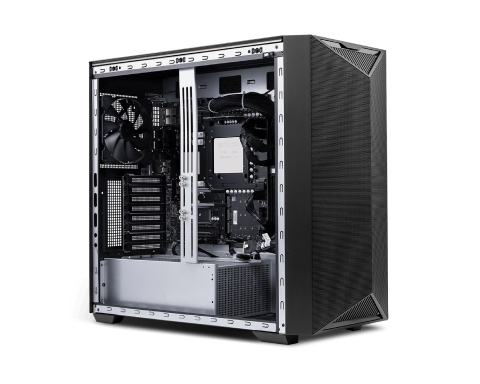
Exxact Valence 4x Max-Q Workstation, NVIDIA DGX Spark, and Exxact Valence built on NVIDIA DGX Station GB300 deliver data‑center‑class AI performance to run bleeding-edge models and agentic AI locally. Your entire AI usage and data in your control.
Get a Quote Today| Spec | Exxact Valence with GB300 | 4x RTX PRO 6000 Blackwell Max-Q |
|---|---|---|
| Processor | NVIDIA Grace | AMD Threadripper PRO 9000WX |
| Memory architecture | 748GB unified, coherent CPU+GPU pool | 384GB total, 96GB per card, not unified |
| Best-fit model size | 200B+ parameters, single large model | Up to ~80B parameters per instance, several in parallel |
| Parallelism model | One workload at a time across the full pool. Can split this pool too. | Multiple independent workloads, one per GPU |
| Cross-device coherence | Native, hardware-level via NVLink-C2C | Software-managed, via NCCL over PCIe |
| Compute | Up to 20 PFLOPS FP4 (sparse) | Aggregate of four discrete Blackwell GPUs |
| Form factor | Single SKU, fixed configuration | Build-your-own multi-GPU tower |
| Alternate use cases | AI-only; not a general graphics or rendering platform. Can add a PCIe GPU. | Rendering, simulation, and other GPU workloads when not running agents |
| Availability | Newer platform, OEM-built, currently more constrained | Broadly available through existing GPU channels |
The two systems take very different approaches to running models that exceed a single GPU's memory capacity.
The two systems also diverge on how they get bought and how they grow.
The two systems also differ in how broadly they can support workloads beyond agentic AI.
| Comparison | Exxact Valence with GB300 | Exxact Valence 4x Max-Q |
|---|---|---|
| Model handling | Large models can use one unified memory pool without manual partitioning across devices. | Models exceeding one GPU's 96GB typically require tensor or pipeline parallelism across multiple GPUs. |
| Memory coherence | Hardware-coherent CPU and GPU address space. | Four separate 96GB GPU memory pools; memory is not unified. |
| Cross-device communication | Uses the coherent architecture to reduce the engineering complexity of running very large models and long-context workloads. | Tensor shards and layer boundaries move over PCIe through software frameworks such as NCCL, adding latency and engineering overhead. |
| Configuration | Single, fixed-configuration SKU. | Configurable multi-GPU workstation with control over CPU, storage, chassis, and GPU count. |
| Maximum platform power | Up to 1,600W for the DGX Station platform. | Up to 1200W for four 300W GPUs before accounting for the rest of the system. |
| Cooling and integration | Pre-integrated platform with system-level power and cooling designed for the fixed configuration. | Requires higher-capacity power supplies, deliberate airflow planning, and multi-GPU system integration. |
| Upgrade path | The coherent memory pool is fixed at purchase; further scaling requires moving to a larger DGX platform. | Can be upgraded incrementally by adding or replacing GPUs and reallocating cards among workloads. |
| Workload allocation | Optimized for large-model training and inference using the coherent memory architecture. | Individual GPUs can be assigned to separate AI, visualization, rendering, or simulation workloads. |
| Use case flexibility | Purpose-built for large-model AI workloads; less suited to unrelated GPU work. | Supports agentic AI as well as rendering, CFD simulation, CAD, and other GPU-accelerated workloads. |
| Best fit | Very large models, long-context agents, and workloads that benefit from a single coherent memory space. Can also do multiple agents. | Multiple independent agents and mixed professional workloads that benefit from four discrete GPUs. |
It can host multiple models within its unified memory, but it doesn't isolate them onto separate physical GPUs the way four discrete cards do, so true hardware-level parallelism across independent workloads favors the multi-GPU build.
It depends on configuration, but a multi-GPU tower generally offers more control over cost by letting buyers choose CPU, storage, and card count independently, rather than buying a fixed platform.
The Exxact Valence with GB300's larger unified pool and coherent memory make it better suited to fine-tuning models that don't fit in 96GB. Smaller models in the 30-70B range can be fine-tuned effectively on a single RTX PRO 6000 card.
Yes. Some teams run day-to-day agent serving on a multi-GPU RTX PRO 6000 tower and reserve an Exxact Valence with GB300 for the largest models or heaviest fine-tuning runs.
The decision between an Exxact Valence with GB300 and a 4x RTX PRO 6000 build comes down to workload shape, not raw specs. If the goal is a single very large model or a long-context agent orchestrator, the coherent memory pool on the Exxact Valence with GB300 removes a real engineering problem. If the goal is running many independent agents or models in parallel, or keeping the hardware flexible for non-AI GPU work, four discrete cards give more parallelism and more day-to-day versatility.
| Question | Favors |
|---|---|
| Does one workload need to hold a 200B+ parameter model or a very long context in memory at once? | Exxact Valence with GB300 |
| Do you need several independent agents or models running in parallel, each isolated to its own GPU? | Exxact Valence 4x Max-Q |
| Does the hardware need to double as a rendering or simulation workstation between AI jobs? | Exxact Valence 4x Max-Q |
| Is a single, pre-integrated SKU preferable to assembling and validating a multi-GPU build? | Exxact Valence with GB300 |
| Is availability today a hard constraint? | Exxact Valence 4x Max-Q given current lead time on the Exxact Valence with GB300 |
Exxact offers both our Exxact Valence with GB300 workstation as well as the Exxact Valence 4x Max-Q workstation as configurable systems. Contact Us for more information!
Exxact Valence 4x Max-Q Workstation, NVIDIA DGX Spark, and Exxact Valence built on NVIDIA DGX Station GB300 deliver data‑center‑class AI performance to run bleeding-edge models and agentic AI locally. Your entire AI usage and data in your control.
Get a Quote TodayAgentic AI workloads rarely fail because a team picked the wrong GPU. They fail because a team picked the wrong shape of hardware for the workload. A single agent orchestrating a 200 billion-parameter model with long context needs a very different memory layout than a team running a dozen smaller agents in parallel, and the two most common local-AI answers today, the Exxact Valence with GB300 and a tower carrying four NVIDIA RTX PRO 6000 Blackwell GPUs, are optimized for exactly those two different shapes. Neither wins outright. The right pick depends on whether the workload goal is one large model or several independent ones running at the same time.
The Exxact Valence with GB300 is built on NVIDIA's DGX™ Station architecture, centered on the GB300 Grace Blackwell Ultra Superchip: a 72-core Grace CPU and a Blackwell Ultra GPU joined by a 900GB/s NVLink-C2C interconnect. The CPU and GPU share a single coherent memory pool of up to 748GB, made up of 252GB of HBM3e GPU memory and 496GB of LPDDR5X system memory. Common use cases for this class of system include:
NVIDIA rates the platform at up to 20 petaflops of FP4 compute with sparsity, and NVFP4, the 4-bit floating point format native to Blackwell, is what makes fitting models of this size into the coherent pool practical at all.
The Exxact Valence 4x Max-Q is our configurable workstation proudly featuring four non-thermally-throttling NVIDIA RTX PRO 6000 Max-Q GPUs each with 96GB of GDDR7 memory and 1.8TB/s of memory bandwidth. Four of them in one workstation total 384GB of VRAM, but that memory is not unified. Each card holds its own allocation, and any workload that needs to reach across cards does so over PCIe rather than a single coherent address space. Common use cases for a 4-card configuration include:
Exxact Valence 4x Max-Q Workstation, NVIDIA DGX Spark, and Exxact Valence built on NVIDIA DGX Station GB300 deliver data‑center‑class AI performance to run bleeding-edge models and agentic AI locally. Your entire AI usage and data in your control.
Get a Quote Today| Spec | Exxact Valence with GB300 | 4x RTX PRO 6000 Blackwell Max-Q |
|---|---|---|
| Processor | NVIDIA Grace | AMD Threadripper PRO 9000WX |
| Memory architecture | 748GB unified, coherent CPU+GPU pool | 384GB total, 96GB per card, not unified |
| Best-fit model size | 200B+ parameters, single large model | Up to ~80B parameters per instance, several in parallel |
| Parallelism model | One workload at a time across the full pool. Can split this pool too. | Multiple independent workloads, one per GPU |
| Cross-device coherence | Native, hardware-level via NVLink-C2C | Software-managed, via NCCL over PCIe |
| Compute | Up to 20 PFLOPS FP4 (sparse) | Aggregate of four discrete Blackwell GPUs |
| Form factor | Single SKU, fixed configuration | Build-your-own multi-GPU tower |
| Alternate use cases | AI-only; not a general graphics or rendering platform. Can add a PCIe GPU. | Rendering, simulation, and other GPU workloads when not running agents |
| Availability | Newer platform, OEM-built, currently more constrained | Broadly available through existing GPU channels |
The two systems take very different approaches to running models that exceed a single GPU's memory capacity.
The two systems also diverge on how they get bought and how they grow.
The two systems also differ in how broadly they can support workloads beyond agentic AI.
| Comparison | Exxact Valence with GB300 | Exxact Valence 4x Max-Q |
|---|---|---|
| Model handling | Large models can use one unified memory pool without manual partitioning across devices. | Models exceeding one GPU's 96GB typically require tensor or pipeline parallelism across multiple GPUs. |
| Memory coherence | Hardware-coherent CPU and GPU address space. | Four separate 96GB GPU memory pools; memory is not unified. |
| Cross-device communication | Uses the coherent architecture to reduce the engineering complexity of running very large models and long-context workloads. | Tensor shards and layer boundaries move over PCIe through software frameworks such as NCCL, adding latency and engineering overhead. |
| Configuration | Single, fixed-configuration SKU. | Configurable multi-GPU workstation with control over CPU, storage, chassis, and GPU count. |
| Maximum platform power | Up to 1,600W for the DGX Station platform. | Up to 1200W for four 300W GPUs before accounting for the rest of the system. |
| Cooling and integration | Pre-integrated platform with system-level power and cooling designed for the fixed configuration. | Requires higher-capacity power supplies, deliberate airflow planning, and multi-GPU system integration. |
| Upgrade path | The coherent memory pool is fixed at purchase; further scaling requires moving to a larger DGX platform. | Can be upgraded incrementally by adding or replacing GPUs and reallocating cards among workloads. |
| Workload allocation | Optimized for large-model training and inference using the coherent memory architecture. | Individual GPUs can be assigned to separate AI, visualization, rendering, or simulation workloads. |
| Use case flexibility | Purpose-built for large-model AI workloads; less suited to unrelated GPU work. | Supports agentic AI as well as rendering, CFD simulation, CAD, and other GPU-accelerated workloads. |
| Best fit | Very large models, long-context agents, and workloads that benefit from a single coherent memory space. Can also do multiple agents. | Multiple independent agents and mixed professional workloads that benefit from four discrete GPUs. |
It can host multiple models within its unified memory, but it doesn't isolate them onto separate physical GPUs the way four discrete cards do, so true hardware-level parallelism across independent workloads favors the multi-GPU build.
It depends on configuration, but a multi-GPU tower generally offers more control over cost by letting buyers choose CPU, storage, and card count independently, rather than buying a fixed platform.
The Exxact Valence with GB300's larger unified pool and coherent memory make it better suited to fine-tuning models that don't fit in 96GB. Smaller models in the 30-70B range can be fine-tuned effectively on a single RTX PRO 6000 card.
Yes. Some teams run day-to-day agent serving on a multi-GPU RTX PRO 6000 tower and reserve an Exxact Valence with GB300 for the largest models or heaviest fine-tuning runs.
The decision between an Exxact Valence with GB300 and a 4x RTX PRO 6000 build comes down to workload shape, not raw specs. If the goal is a single very large model or a long-context agent orchestrator, the coherent memory pool on the Exxact Valence with GB300 removes a real engineering problem. If the goal is running many independent agents or models in parallel, or keeping the hardware flexible for non-AI GPU work, four discrete cards give more parallelism and more day-to-day versatility.
| Question | Favors |
|---|---|
| Does one workload need to hold a 200B+ parameter model or a very long context in memory at once? | Exxact Valence with GB300 |
| Do you need several independent agents or models running in parallel, each isolated to its own GPU? | Exxact Valence 4x Max-Q |
| Does the hardware need to double as a rendering or simulation workstation between AI jobs? | Exxact Valence 4x Max-Q |
| Is a single, pre-integrated SKU preferable to assembling and validating a multi-GPU build? | Exxact Valence with GB300 |
| Is availability today a hard constraint? | Exxact Valence 4x Max-Q given current lead time on the Exxact Valence with GB300 |
Exxact offers both our Exxact Valence with GB300 workstation as well as the Exxact Valence 4x Max-Q workstation as configurable systems. Contact Us for more information!
Exxact Valence 4x Max-Q Workstation, NVIDIA DGX Spark, and Exxact Valence built on NVIDIA DGX Station GB300 deliver data‑center‑class AI performance to run bleeding-edge models and agentic AI locally. Your entire AI usage and data in your control.
Get a Quote Today